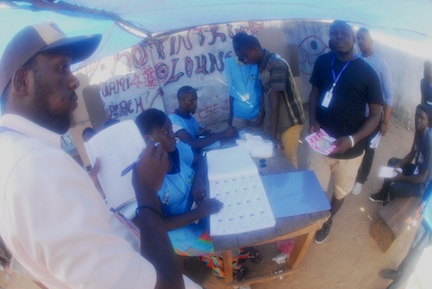
Presidential election runoff... the polls were quiet, relaxed and relatively efficient. Sierra Leone is never without "challenges" however... and there were lots. But, on the whole, things were good.
It's not exactly technologically sound... but who needs technology when it can be hacked??? Or so some people thought. Everything must be done "manually" according to a court order issued on the National Electoral Commission... a bit of nonsense... but we're so paranoid here that counting one by one by one by one... and then carrying the boxes straight to a headquarters - bristling with guns and military-types - is the only way we can do this without trickery and deceit.
Wednesday, April 4, 2018
Saturday, December 9, 2017
The Sierra Leone Association of Journalists
(SLAJ)
Supported by the Canada Fund for Local
Initiatives (CFLI)
Promoting
democratic and political processes
Political Reporting
– training and monitoring
In 2012, the Government of Sierra Leone
invited an observer mission from the European Union to monitor and observe the
17 November 2012 general elections. Over 100 observers were deployed to the 14
Districts of Sierra Leone from EU member states and Norway. Part of what that
EU mission did was to monitor media coverage of the campaign, candidates and
elections. Some media outlets did
well, according to the EU independent observers. But, there were some
fundamental flaws in the way media covered the elections as well.
For example, on the Sierra
Leone Broadcasting Corporation (SLBC) television, the ruling party and
incumbent All Peoples Congress (APC) received 61% of airtime coverage. On SLBC
radio, 40.5% of coverage was devoted to the incumbent party and 23% to the main
opposition party, the Sierra Leone Peoples Party (SLPP). None of the remaining seven parties received more than 8.5% of
coverage either on SLBC Radio or on SLBC TV. These independent statistics were
and are being refuted by the SLBC management.
Out of the nine private media monitored by the EU EOM,
four media outlets showed
significant unbalances in allocation of time/space and
tone in favour of APC, and one in favour of SLPP.
Clearly, the
independent EU observers identified issues of concern regarding how the Sierra
Leone media cover elections, campaigns and candidates. One strategy that SLAJ
and the media are using to help address these and other concerns is to further
train and monitor the media.
The Sierra Leone Association of Journalists
(SLAJ) began a series of training workshops, funded by the Canada Fund for
Local Initiatives (CFLI), for 25 SLAJ members and journalists from around the
country on 26 November and continued the training with another group of 25
journalists on 4 December 2017. Each of the training workshops lasted for
three-days and featured seasoned media educators Francis Sowa and Stephen
Douglas along with special guests from the National Electoral Commission (NEC)
and the Political Parties Registration Commission (PPRC). The final guest was
Umaru Fofana of the BBC who spoke about staying safe in potentially hostile
settings.
The training sessions opened with a review
of the media landscape and included the EU observer mission notes. Participants
then rated the current media situation based on the following criteria:
balance, fairness, accuracy, technology and integrity, among others.
Unfortunately, according to participant feedback, the media did not score very
well receiving an average mark of less than 30%. Participants consensually
agreed the media need to do a better job of reporting on political issues and
elections.
The role of the media in elections coverage
and democracy was explored and again it was agreed, “The media plays a very important role in a democracy.
It is up to journalists, as well as voters, to find out what different parties
stand for and to inform citizens about their policies and all the big issues,”
summarized one participant.
Another participant added, “The aim of any election coverage is to ensure that the electorate is
able to make an informed choice. Voters are entitled to accurate, fair,
impartial and balanced information about the election procedures and the
positions of political parties/independents and/or candidates on issues.” It
was clear that many journalists understand the importance of their work.
Stephen Douglas led a session on
conflict-sensitive reporting and how to avoid reporting techniques that may
enflame vs calm a potentially volatile situation. Defamatory and malicious
reporting was discussed at length. The issue of hate speech was reviewed and
specific examples were cited. Hate speech is a horrible abuse of someone’s
tribe, nationality or sex and could lead to all kinds of problems. A reporter’s
choice of words was carefully examined and a series of headlines were
discussed. “Political battleground” was used as an example of a headline that
could potentially cause problems. Politics is not a “battle” but a process of
selecting an ideology and commitment to development between political parties.
By referring to politics as a battle, it can conjure images (and memories) of
conflict or war.
As evidenced in a presentation by Francis
Sowa, there are many ways to cover politics and politicians. Sowa led a
discussion on “designing an election plan and programs”. Preparations and
planning were highlighted as key to a media outlet’s coverage.
An interesting debate emerged during a
presentation on “the role of women in politics and how to cover women
candidates”. Generally, the media
fall short of their own accountability role, which is to work and report in the
interest of the public, when women are not given equal access to voice their
opinions and views as sources and when women politicians and candidates are
rendered invisible or only covered in stereotypical ways. The notion of
“gender-aware reporting” was presented and a commitment was made to fully cover
women’s issues and women’s voices.
SLAJ hosted three special guest speakers
during the three days of training. Lucien Momoh of the Political Parties
Registration Commission (PPRC) presented information on the political parties
and their constitutions. He noted, “As a regulatory body, the PPRC tries to
ensure political parties follow the rules as laid out in the national
Constitution.” Participants were enthralled as Momoh described the requirements
for party registration and the financial reporting demands of the PPRC.
The legal framework for elections and
voting were explained by Albert Massaquoi of the National Electoral Commission
(NEC). The process of conducting elections falls on the shoulders of the NEC
and Massaquoi was very thorough in his explanation of how elections should be
conducted to ensure a fair and credible process.
Elections and campaigns can be volatile and
sometimes violent. Umaru Fofana, of the BBC, presented techniques to avoid harm
and stay safe while reporting in potentially hostile situations. Fofana spoke
about threats to journalists and listed; political party militants or
extremists, security forces and criminals, who may want to take advantage of
crowds or rallies. He also reviewed things a journalist could or should do to
avoid harm and stay safe such as never wearing party colours, remaining behind
security forces and always being aware of your surroundings. Fofana’s
experiences and detailed story-telling techniques added a great deal to his
presentation and generated an abundance of discussion.
The media has three roles to play during an
election campaign, on voting day and throughout the political cycle. First, the media informs people about the
election. The media reports fairly on the campaigns of all the political
parties so the people can make their own choices. It
also presents educational information to tell citizens who the candidates are
and where to vote, and how to cast a vote in secret, etc. And, the media may
carry advertisements from the political parties seeking the people’s support.
Secondly the media is the watchdog over the
fairness of the election campaign and the voting. It is the media’s job to
report if there is no free speech because some candidates are afraid to speak,
or if there is corruption in election and voting procedures, or if the election
management bodies are doing their jobs fairly.
And thirdly the media should be the voice
of the voters. The election is not just for the politicians. An election is
also an opportunity for ordinary people to speak up, to say what issues they
think are important and why. The media should go out into the community and be
the voice of the ordinary voters, and also be the voice for those who cannot
speak up or have been ignored in the past.
The participants at the SLAJ training
agreed, a professional work of journalism must be accurate, verified, balanced,
neutral, gender-aware and respectful of human dignity. Implicit in these
requirements is a sense of morality and of responsibility. Above all, a
journalist’s primary responsibility is to his fellow citizens.
Sunday, January 31, 2016
But you know these things about Canada - right?!?
28 Things You Never Knew About Canada That May Surprise You.
1. Canada consumes more macaroni and cheese than any other nation in the world.
2. Canada is the world's most educated country by percentage: over half its residents have college degrees.
3. Police departments in Canada give out "positive tickets" when they see people doing something positive.
4. Canada's lowest recorded temperature was -81.4 degrees fahrenheit (-63 celsius) in 1947.
5. Canada is the second largest country in the world, right after Russia.
6. Residents of Churchill, Manitoba leave their cars unlocked to offer escape for pedestrians who might encounter polar bears.
7. Canada has more lakes than the rest of the world's lakes combined.
8. The first Canadian casualties of the Afghanistan war were from an American pilot bombing a training exercise.
9. License plates in the Northwest Territories are shaped like polar bears.
10. In 2010, a Canadian man rescued a newborn baby from a dumpster, only to find out he was the father.
11. Canada has the largest coastline in the world.
12. Sometimes in Newfoundland the Atlantic Ocean freezes so people play hockey on it.
13. Until 1999, the Guinness Book of World Records considered Yonge Street in Ontario as the longest street in the world at 1,896 km (1,178 mi).
14. The Mall of America is owned by Canadians.
15. The US/Canada border is the longest international border in the world and it lacks military defense.
16. Canada has no weapons of mass destruction since 1984 and has signed treaties repudiating their possession.
17. After the attack on Pearl Harbor during WWII, Canada declared war on Japan before the U.S. did.
18. "Canada" is an Iroquoian language word meaning "village".
19. Canada's official phone number is 1-800-O-CANADA.
20. Large parts of Canada have less gravity than the rest of Earth. The phenomenon was discovered in the 1960s.
21. Prostitution is legal in Canada. Buying the services of a prostitute is not.
22. Americans have invaded Canada twice, in 1775 and 1812. They lost both times.
23. Canada has the third largest oil reserves of any country in the world after Saudi Arabia and Venezuela.
24. The third country in space, after the US and USSR, was Canada, which was considered to have the most advanced space program in 1962.
25. In Canada, Mexico, India, Russia, and Israel, bank notes have Braille-like markings on them for the blind.
26. Canada has fewer people than Tokyo's metropolitan area.
27. During WWII, Canada gave out buttons to people who tried to enlist but were refused due to medical reasons to show their willingness to fight.
28. The Eiffel Tower was almost temporarily relocated to Canada in 1967.
Wednesday, January 27, 2016
Debating the Safe Abortion Bill
The Safe Abortion Bill was passed unanimously by the people's representatives in Parliament in December 2015. The President, after last-minute lobbying by some religious leaders, refused to sign the Bill and sent it back to Parliament.
Today, some religious leaders presented information to a Parliamentary Committee and urged other "anti-Bill" followers to demonstrate. On the other hand, supporters of the Bill - women's groups, men's associations, CSOs, NGOs, etc., came out to demonstrate their support for the passing of the Bill.
What's astounding to me is the "sameness" of the arguments presented... same as the U.S., Canada, South Africa, U.K., other African countries, etc. These and many other countries have wrestled with the moral, health, development and legal arguments before... and it's clear that countries that have a law regulating abortions have better human rights records, better maternal health statistics, more development for women and children... and ultimately a better society. I just don't see the necessity to re-hash all of these arguments...
Let's just get on with it... make Sierra Leone a better place for women and children... But, this is Sierra Leone...
These pictures are from the rallies at Parliament...
Today, some religious leaders presented information to a Parliamentary Committee and urged other "anti-Bill" followers to demonstrate. On the other hand, supporters of the Bill - women's groups, men's associations, CSOs, NGOs, etc., came out to demonstrate their support for the passing of the Bill.
What's astounding to me is the "sameness" of the arguments presented... same as the U.S., Canada, South Africa, U.K., other African countries, etc. These and many other countries have wrestled with the moral, health, development and legal arguments before... and it's clear that countries that have a law regulating abortions have better human rights records, better maternal health statistics, more development for women and children... and ultimately a better society. I just don't see the necessity to re-hash all of these arguments...
Let's just get on with it... make Sierra Leone a better place for women and children... But, this is Sierra Leone...
These pictures are from the rallies at Parliament...
Thursday, December 31, 2015
State of Emergency – Still?????
Yes, Sierra Leone is Ebola-free (having
gone 42 days or two cycles of incubation periods without a case of Ebola). Yes,
Liberia and Guinea have each clocked “42 days of being Ebola free”. Of course,
Ebola was the big story/occurrence and crisis of 2014-2015 in West Africa.
Whew… I’m glad to be finished… Or are we?
Sierra Leone is still technically under a
“state of emergency” as declared by the President and Parliament back in 2014.
This state of emergency was enacted during the Ebola crisis and remains in
place… Hmmmm, one can ask, “why?” but there will be no answer.
From the Sierra Leone Constitution (now
under review)
29. (1) Whenever in the opinion of the
President a state of public emergency is imminent or has commenced, the
President may, at any time, by Proclamation which shall be published in the
Gazette, declare that—
a. a state
of public emergency exists either in any part, or in the whole of Sierra Leone;
or
b. a
situation exists which, if it is allowed to continue, may lead to a state of
public emergency in any part of or the whole of Sierra Leone.
29. (2) The
President may issue a Proclamation of a state of public emergency only when—
a. Sierra
Leone is at war;
b. Sierra
Leone is in imminent danger of invasion or involvement in a state of war; or
c. there is
actual breakdown of public order and public safety in the whole of Sierra Leone
or any part thereof to such an extent as to require extraordinary measures to
restore peace and security; or
d. there is
a clear and present danger of an actual breakdown of public order and public
safety in the whole of Sierra Leone or any part thereof requiring extraordinary
measures to avert the same; or
e. there is an occurrence of imminent danger,
or the occurrence of any disaster or natural calamity affecting the community
or a section of the community in Sierra Leone; or
f. there is any other public danger which
clearly constitutes a threat to the existence of Sierra Leone.
Ebola was a “calamity affecting the..”.
Ebola was a “public danger … constitutes (ing) a threat to the existence of
Sierra Leone”.
But, under Section 29 of the Constitution
of Sierra Leone the government/President has far-reaching powers including:
i. the taking of possession or control on
behalf of the Government of any property or undertaking;
ii. the acquisition on behalf of the
Government of any property other than land;
c. authorise the entering and search of any
premises;
d. amend any law, suspend the operation of
any law, and apply any law with or without modification: Provided that such
amendment, suspension or modification shall not apply to this Constitution:
e. provide for charging, in respect of the
grant of issue of any license, permit, certificate or other document for the
purpose of the regulations, such fees as may be prescribed by or under the
regulations;
f. provide for payment of compensation and
remuneration to persons affected by the regulations;
g. provide for the apprehension, trial and
punishment of persons offending against the regulations;
h. provide for maintaining such supplies
and services as are, in the opinion of the President, essential to the life and
well-being of the community: Provided that nothing in this subsection shall
authorise the making of regulations during a period of public emergency for the
trial of persons who are not members of defence forces by military courts.
Ebola was a crisis… an emergency… a threat
to the public order of Sierra Leone… therefore it was probably necessary to
declare this state of public emergency – Section 29 of the Constitution. Liberia
lifted their state of emergency long ago… Guinea, I’m not sure… but Sierra
Leone???? Hmmmm, almost unlimited powers to the President… makes me a little
worried. The President said Parliament was considering lifting the state of
emergency at the official announcement of the end of Ebola on November 7th.
But, till today… we’re still under this “emergency umbrella”. Like so many
things in Sierra Leone – it can’t be explained.
Subscribe to:
Comments (Atom)