Monday, August 11, 2014

First piece for the Globe and Mail - Canada

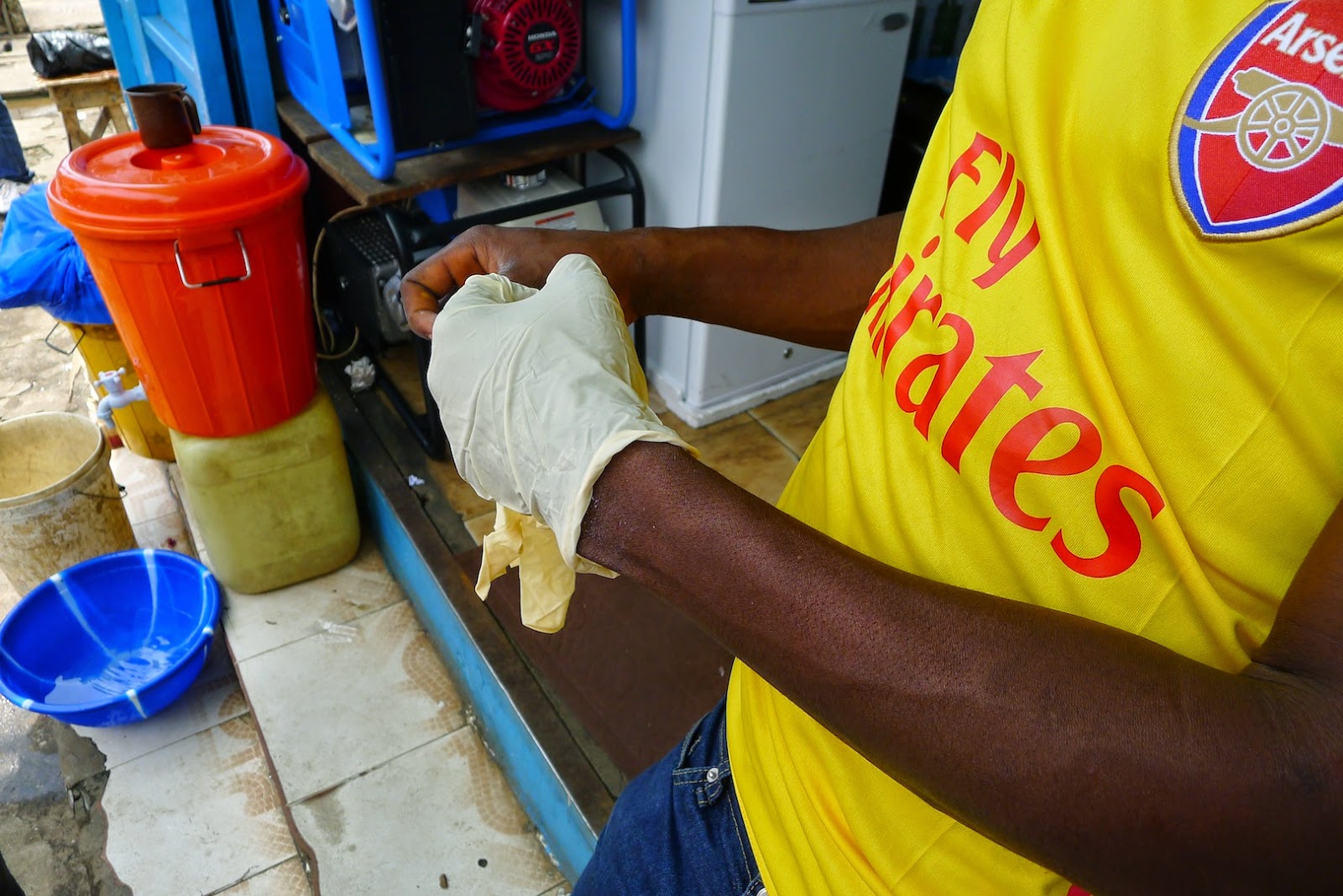
The shop security guys, clad in plastic gloves, call out, “wash, wash”, outside the electronics shop on Siaka Stevens Street in central Freetown. They’re standing beside a bucket with a mixture of chlorine bleach and water encouraging passers-by to dip their hands in the mixture. Fatmata, who’s standing next to the shop, is selling plastic gloves and chlorine tablets from a small tray – 2,000 Leones per pair (about 50 cents). Business is brisk in front of the bucket and for Fatmata. Business is very slow inside the shop. I dipped my hands but passed on the gloves. Washing one’s hands is an important part of staying healthy, as we all know, and in this environment where Ebola dominates the news and almost every discussion, it’s even more important.

Sierra Leone is a friendly place where hand shaking and holding hands is part of the culture. Wherever I go, meetings, shops or street corners, I’m usually greeted with smiles and handshakes. I’ve had some of the most interesting conversations while walking hand-in-hand with my friend Sullivan. Now, under the umbrella of Ebola, most people are keeping their hands in their pockets or folded across their chests instead of reaching forward to greet friends and family. Nods and salutes have replaced the familiar, friendly, three-step, hand-grasp-thumb-lock-and-grip greeting.

A group of photographers, with whom I sometimes work, shares space along the sidewalk of Siaka Stevens Street with a group of women selling bananas, cold water in plastic bags and cheap costume jewelry. I bought a banana from Kadija, who fumbled with my change in her gloved hands. As we stood along the street, a green SUV topped with a loud speaker and decorated with about a dozen UNICEF-sponsored Ebola posters inches along in traffic. I hear a distorted, discordant, electronic tune… something about “Ebola ea dae” (Ebola is here). Then, there’s a recorded message in Krio, the lingua franca of Sierra Leone, which crackles and reverberates off the concrete Rokel Bank building. My Krio is decent but I had to ask Kadija what the message was saying. She looked nonplussed as she said, “the government says we shouldn’t touch anyone”. I smile as I suggest that it’s still totally fine for her to hug and hold her children, one of which was looped over her back in a lappa. This over-simplified government message is another example of misinformation being circulated about town. But, how do you convey the more accurate message “don’t touch sick or dead people”?

It’s rainy season here and as I huddle under a blue tarpaulin awning with a small group of “okada” riders (an okada is a small, public motorbike taxi) the conversation immediately turns to the Ebola crisis. I ride my own motorbike around town and so share an affinity with these professional taxi-riders. They tell me stories about witchcraft (juju), Ebola witch guns, crazy nurses injecting neighbours with Ebola, government conspiracies and other nonsensical rumours. Then, in unison, they tell me that we are all in the hands of God and that only God can save Sierra Leone. This is a deeply religious country of Muslims and Christians and many people believe prayer is the only hope against Ebola.

The President of the Republic of Sierra Leone, Ernest Bai Koroma, in his second address to the nation, declared Monday, August 4th as a national “stay-at-home” day for “reflection, education and prayer”. At daybreak, the streets were completely empty as, it seems, the entire country stayed at home. There were no taxis. There were no “poda podas” (converted mini-vans turned into public buses). Stray dogs lounged in the middle of usually busy intersections. Police and security forces strolled empty sidewalks… and all businesses, shops, offices and street markets were closed. The eerie quiet and unusual emptiness was a bit disconcerting. As I strolled through the Aberdeen neighbourhood in the west of Freetown, I noticed women braiding each other’s hair, cooking fires covered with big pots of boiling cassava leaf stew, young folks sweeping porches and older folks listening to radio broadcasts. There was a lot of sitting around… talking, discussing, watching and praying.

I was recently at the water taxi, which shuttles air travellers between the Lungi Airport and the shores of Freetown. I met a group of Latter Day Saints guys who’d come to Sierra Leone to do missionary work. Their white shirts gleamed and they’d gathered their luggage in anticipation of the boat ride across to the airport. I asked about their plans and they informed me that they were being “recalled” because of the Ebola crisis. Most of the young guys were from the U.S. and were leaving Sierra Leone along with the Peace Corps volunteers because of the perceived risks. I told Mark, the only one in a suit jacket, that I didn’t think the risk was overly great. I asked if they worked in hospitals. “No”. I asked if they touched sick or dead people. “No”. In my mind, their organization’s response to the situation here was overly dramatic and not entirely based on evidence.

People are afraid of the Ebola virus and rightfully so. But, I’m hoping factual and clear information can help allay some of this fear. Ebola is here and primarily affecting people who treat sick people, professional healthcare workers and close contacts. Healthy caution, awareness of the facts and a preventative mindset is in order. But, there’s no question it’s affecting many people’s lives. This is a close-knit country, for the most part. People went to school together, were from the same or close-by village, are related by marriage or politics. Everyone seems to know everyone else and undoubtedly will be touched by this disease in one way or another.

And, ebola has touched my life beyond the street conversations and dinner table debates. My friend, Hawa Rebecca, a nurse in Kenema, was recently tested for Ebola. She was positive. Two days ago she was “responding to treatment” in the Kenema Hospital. This morning, she died. She left behind three young children and countless other family members who relied on her small income. Ebola is here and it’s affecting us all.


Friday, August 1, 2014

People are very guarded...

From a Toronto Star article written by Jennifer Yang on July 31st.

In the capital Freetown — which is 400 km west of the outbreak epicentre in eastern Sierra Leone — the fear on the streets is now “palpable,” said Stephen Douglas, a Canadian media development professional who has lived in the country for five years.
“People are selling plastic gloves, rubber gloves, and there are buckets of chlorine set up on street corners,” he said. “It’s not panic yet . . . (but there is) more and more fear and people are very guarded.”

CDC warns travellers

The announcement was made last night... August 1, 2014. Travel warnings... from the CDC in the US. 

Updated: July 31, 2014
CDC urges all US residents to avoid nonessential travel to Sierra Leone, Guinea, and Liberiabecause of an unprecedented outbreak of Ebola.
What is the current situation?
An outbreak of Ebola has been ongoing in Sierra Leone since May 2014. This outbreak also affects Liberia and Guinea; to date more than 1320 cases have occurred in the three countries and more than 725 people have died, making this the largest outbreak of Ebola in history. At least three Americans have been infected; two are health care workers in an Ebola clinic. Affected districts in Sierra Leone include Bo, Bombali, Bonthe, Kailahun, Kambia, Kenema, Kono, Moyamba, Port Loko, Tonkolili, and Western Area, including the capital of Freetown. Instances of civil unrest and violence against aid workers have been reported in West Africa as a result of the outbreak. The public health infrastructure in Sierra Leone is being severely strained as the outbreak grows.
Sierra Leone’s government has recently instituted enhanced measures to combat the spread of Ebola, many of which will likely make travel to, from, and within the country difficult. The government has taken the following steps:
·       Instituted new protocols for arriving and departing passengers at Lungi International Airport.
·       Instituted restrictions on public and other mass gatherings.
·       Instituted quarantine measures for communities affected by Ebola; travel in and out of those communities will be restricted until a medical team clears them.
·       Authorized house-to-house searches to locate and quarantine Ebola patients and requires all deaths be reported before burial.
·       Authorized police and military personnel to aid in enforcing these and other prevention and control measures.
·       Requires local government officials to establish by-laws to support Ebola prevention efforts.
CDC recommends that US residents avoid nonessential travel to Sierra Leone. If you must travel, such as for humanitarian aid work in response to the outbreak, protect yourself by following CDC’s advice for avoiding contact with the blood and body fluids of people who are ill with Ebola. For more information, visit Outbreak of Ebola in Guinea, Liberia, and Sierra Leone on the CDC Ebola website
This recommendation to avoid nonessential travel is intended to facilitate control of the outbreak and prevent continued spread in two ways: to protect US residents who may be planning travel to the affected areas and to enable the government of Sierra Leone to respond most effectively to contain this outbreak. CDC remains committed to the multinational effort to assist Sierra Leone in controlling the outbreak and is scaling up its response activities by, among other things, deploying additional staff to the affected countries. International humanitarian assistance must continue, and CDC encourages airlines to continue flights to and from the region to facilitate transport of teams and supplies essential to control the outbreak.
What is Ebola?
Ebola virus disease (also known as Ebola hemorrhagic fever) is a rare and deadly disease. The disease is native to several African countries and is caused by infection with one of the ebolaviruses (Ebola, Sudan, Bundibugyo, or Taï Forest virus). It is spread by direct contact with a sick person’s blood or body fluids. It is also spread by contact with contaminated objects or infected animals.
Symptoms include fever, headache, joint and muscle aches, sore throat, and weakness, followed by diarrhea, vomiting, and stomach pain. Skin rash, red eyes, and internal and external bleeding may be seen in some patients.
Who is at risk?
Travelers could be infected if they come into contact with blood or body fluids from someone who is sick or has died from Ebola, sick wildlife, or meat from an infected animal. Health care providers caring for Ebola patients and family and friends in close contact with an ill person are at highest risk because they may come into contact with blood or body fluids.
What can travelers do to prevent Ebola?
There is no vaccine or specific treatment for Ebola, and many people who get the disease die. Therefore, it is important to take steps to prevent Ebola.
·       Avoid nonessential travel to Liberia, Guinea, and Sierra Leone.
·       If you must travel, please make sure to do the following:
o   Practice careful hygiene. Avoid contact with blood and body fluids. 
o   Do not handle items that may have come in contact with an infected person’s blood or body fluids.
o   Avoid funeral or burial rituals that require handling the body of someone who has died from Ebola.
o   Avoid contact with animals or with raw meat.
o   Avoid hospitals where Ebola patients are being treated. The US Embassy or consulate is often able to provide advice on facilities that are suitable for your needs. The US Embassy in Freetown can be reached at +(232) 76-515-000.
o   Seek medical care immediately if you develop fever, headache, achiness, sore throat, diarrhea, vomiting, stomach pain, rash, or red eyes.
§  Limit your contact with other people when you travel to the doctor. Do not travel anywhere else.
o   Pay attention to your health after you return.
§  Monitor your health for 10 days if you were in an area with an Ebola outbreak but were not in contact with blood or body fluids, items that have come in contact with blood or body fluids, animals or raw meat, or hospitals where Ebola patients are being treated.
§  Monitor your health for 21 days if you think you might have been exposed to Ebola.
§  Seek medical care immediately if you develop fever, headache, achiness, sore throat, diarrhea, vomiting, stomach pain, rash, or red eyes.
§  Tell the doctor about your recent travel and your symptoms before you go to the office or emergency room. Advance notice will help the doctor care for you and protect other people who may be in the office.
Special Recommendation for Health Care Workers
Health care workers who may be exposed to people with the disease should follow these steps:
·       Wear protective clothing, including masks, gloves, gowns, and eye protection.
·       Practice proper infection control and sterilization measures. For more information, see “Infection Control for Viral Hemorrhagic Fevers in the African Health Care Setting.”
·       Isolate Ebola patients from unprotected people.
·       Avoid direct contact with the bodies of people who have died from Ebola.
·       Notify health officials if you have been exposed to someone with Ebola.
Traveler Information
·       CDC Ebola factsheet
·       CDC Ebola website
Clinician Information
·       CDC Ebola website
·       Viral Hemorrhagic Fevers in CDC Health Information for International Travelers 2014—"Yellow Book"
Information for Airline Personnel

Thursday, July 31, 2014

Plastic gloves on the streets of Freetown

On the streets of Freetown... plastic gloves are selling for Le2,000 a pair... Quite steep when you consider a "cookery" plate of rice and plassas (cassava leaf, potato leaf or ground nut stew) costs Le5,000. I took these photos on July 31st, the day after President Koroma announced a national state of emergency over the Ebola crisis.

 One shop was also encouraging passers-by to dip their hands in the chlorinated water...

My friends at RIM Investment where I buy my phone top-up. They're worried about transmission of Ebola from the paper money.

 Selling chlorine tablets and plastic gloves on Siaka Stevens Street in downtown Freetown.

 Gloves for sale... And, I should add that this woman, Fatmata, was doing a booming business.

 Martha sells cold water in plastic bags... and was worried about greeting people and handling money.

These two guys stepped out of a government office and immediately donned their gloves... telling me "it's better to be safe than sorry".

Monday, July 7, 2014

You can’t keep an okada down…

For those who haven’t read several of my previous blog posts… an “okada” is a public, motorcycle “taxi” driven by a young, male (I’ve only seen one woman) driver… who picks up passengers to hurry them to work, to market, to home, to court, to visit girlfriends/boyfriends, to hospitals, to funerals, to family and sometimes to the police station. Okadas can weave between traffic… between lanes (down the centre of roads between traffic, usually) across walkways, up trails and down pathways. They go where no car, truck or bus would ever dream to venture.

The 125cc motorbikes are made by an Indian company, TVS or Baja, and have an extended seat for passengers, goats, bags of rice, car tires, wardrobes, baskets of fish, bags of charcoal, pregnant women, children… Yes, almost anything and everything goes atop an okada. They are strong, sturdy, reliable, rugged and reasonably priced. The average motorbike costs about Le 6,000,000 or roughly $1,300. Second-hand parts are plentiful and almost every street corner sports a mechanic or two who can install gaskets, fix brakes, repair flat tires, change lightbulbs, etc.

In my opinion, okadas are an essential and integral part of the transport system here in Sierra Leone. Okadas are everywhere… the capital city, Freetown, provincial towns, border towns, villages, up the hills and across the nation.

The guys who ride, most anyway, are decent sorts… trying to earn a little money to pay school fees for their children, put themselves through college, pay medical bills for ailing family members or just put food in the pot. And most of these riders can’t find decent jobs that would take them off their bikes. Some are illiterate. Some only speak native languages. Some are former combatants. Some are college graduates. Some are orphans. Some are former convicts.

Some riders carry driver’s licenses. Some of the bikes are insured. Some of the okadas are properly registered… but many are not. Part of the problem with illegal okadas is the cost to license and register a commercial motorbike with the SL Road Transport Authority. According to a rider-friend, it cost him almost Le 800,000 ($175 or so) to register his commercial bike. He told me, “I’d rather just pay the police to let me off because that’s only Le 10,000/day.”

To ride an okada in Freetown is not easy, as they say here. I’ve asked around and learned a little about the economy of being an okada rider. First, they have to rent the bike from a “master”. Most okada guys don’t own their own bike. It costs anywhere from Le 40–50,000 (around $10) per day to rent a bike. Then there’s fuel… about 10 litres (enough for a day) costs Le 45,000. Police bribes cost between Le 10–20,000 per day… to avoid being arrested. If stopped/arrested by the police (if the officer is having a bad day) it’ll cost the rider up to Le 50,000 to get his bike back. If they are “charged to court” a rider faces a Le 150,000 ticket… and probably a year in jail (a hell I’m thankful to avoid). An average rider can make (depending on the weather) around Le 60–80,000 a day. Now, take away expenses… and these guys are barely scraping together Le 20,000 a day (under $5/day).

Now… getting to the point of this diatribe.

About a year ago, the government of Sierra Leone (GOSL) tried to stop the okadas from using some of the streets in the centre of Freetown. They said the okadas were “lawless and indecent”… dangerous and useless. The GOSL quoted non-existent accident reports… non-existent medical evidence, non-existent police files, etc. in their public relations campaign.

The GOSL definitely get an “A” for effort… And, as they say around here, “they tried”. To give the government of Sierra Leone credit, they tried almost everything… extra police, newly recruited “azonto” police, beatings, random arrests, sporadic checks of paperwork, Operation W.I.D. (I can’t recall what that even stood for), Presidential task forces, road monitors, bike rider union task forces, “spike rods” (long pieces of wood with nails driven through to flatten tires) … and even SL Road Transport Wardens. But, nothing worked… and okadas are still plying the streets.

The GOSL spent untold hundreds of thousands of dollars… billions of Leones… trying to enforce a law that doesn’t exist (limiting vehicles from certain roads). The GOSL instituted “operations” without any legal basis. The GOSL violated the human rights of hundreds of young men. The GOSL broke their own laws. The GOSL violated the Constitution (only police have the right to enforce the law). The GOSL divided the bike riders union by choosing some members to be “enforcers” over their brother riders. The GOSL sold licenses and registrations to commercial bike riders and then told them NOT to ride on certain streets in town.

It was a big mess for a while there… and the streets became even more dangerous as “illegal” okadas twisted and turned to avoid being caught by authorities. Of course, the minute the police left their post (around 7 p.m.)… or turned their back, okadas were swarming the streets again. Okadas would speed through police checks. Okadas would jump sidewalks to avoid being captured. And, it became a game for the okada riders… signaling to each other where to avoid and where to zip along. I remember watching an okada rider out-maneuver several police officers and I thought to myself… this is a scene from a “keystone kop” comedy.

It would be hilarious if it weren’t so serious… and dangerous.


So, after spending all that money and effort, the okadas are still plying the roads in downtown Freetown… And I, along with my okada brothers, will continue to zip along the roads on my privately licensed, insured and registered, red motorbike… wearing my helmet and my boots, of course. I have a good friend who calls me the "oCadaidian"... Funny stuff. 

Sunday, July 6, 2014

This is from a WHO info sheet... on Ebola

The evolution of the Ebola virus disease outbreak in Guinea, Sierra Leone and Liberia remains a serious concern as primary and secondary viral transmissions continue to occur in both urban and rural communities. Analyses of the current trend and the potential risk factors for the continuing spread of this epidemic have been conducted. The major factors responsible for continuous propagation of EVD outbreak in the sub-region include:
1. Some negative cultural practices and traditional beliefs, resulting into mistrust, apprehension and resistance to adopt recommended public health preventive measures. The implication of this include poor health care seeking behaviour such as hiding of EVD patients, home-based management of EVD patients, and customary treatment of dead bodies. These are very high risk practices leading to extensive exposures to Ebola virus in the community. Consequently, community deaths continue to be reported. In addition, the potential contacts to the EVD patients managed at home and exposures during customary burial procedures are not systematically identified and put under observation (very critical measures for containment of community transmission of Ebola virus). This is therefore a major factor amplifying the outbreak.
2. The extensive movement of people within and across borders has facilitated rapid spread of the infection across and within the three countries. The homogeneous community living along the border areas have common socio-cultural activities that enhance viral transmission e.g. visiting sick relatives or attending to burial ceremonies of relatives across the border. In addition, the cross border movement has complicated tracking and follow up of contacts, with several contacts loss to follow up.
3. Currently, the coverage of effective outbreak containment measures is not comprehensive. The unprecedented geographical expanse of the EVD outbreak in the three countries requires enormous and robust response capacity and structures in terms of human capital, financial, operational and logistics requirements. This is the first major EVD outbreak in West Africa and the affected countries had weak capacity and structures for epidemic preparedness and response, particularly for viral haemorrhagic fever. Lastly, the apprehension of some communities limits access to affected population with effective outbreak control measures.